In this guide
- Introduction to Lower Secondary Mathematics in Singapore
- What Is the Difference Between Sec 1 and Sec 2 Mathematics in Singapore?
- Three Main Areas of the Lower Secondary Mathematics Syllabus in Singapore
- What Skills Do Students Develop Through Lower Secondary Maths in Singapore?
- Common Challenges Students Face in Lower Secondary Mathematics in Singapore
- How Can Parents Help Their Children Improve in Lower Secondary Mathematics?
- How to Prepare for Sec 1 Maths After the PSLE
- How Is Lower Secondary Mathematics Assessed in Singapore?
- When Should Students Consider Lower Secondary Maths Tuition in Singapore?
- Lower Secondary Mathematics in Singapore: Frequently Asked Questions
Introduction to Lower Secondary Mathematics in Singapore
Many parents ask the same question when their child moves up from Primary 6: what does lower secondary Mathematics in Singapore actually cover, and why does it feel so different from primary school? In Secondary 1 and 2, Maths moves from mostly arithmetic and word problems to algebra, geometry and data, with more reasoning and less routine calculation.
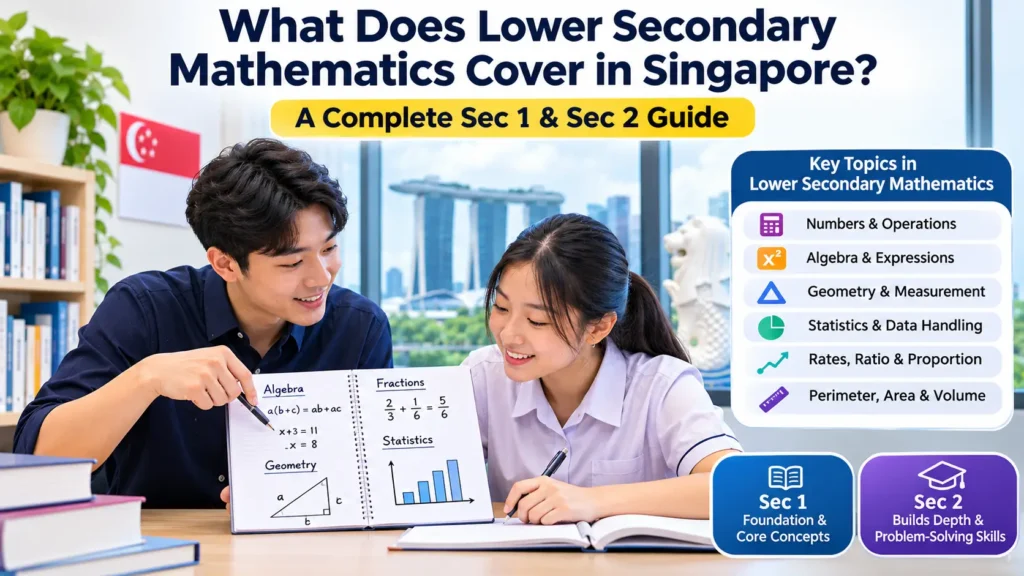
MOE organises the secondary Mathematics syllabus into three strands: Number and Algebra, Geometry and Measurement, and Statistics and Probability. It is a spiral curriculum, which means topics return in later years in more depth, so Sec 1 and Sec 2 build the base for everything that follows, including O-Level Elementary Mathematics, which will become part of the SEC from 2027.
This guide explains what is taught in Sec 1 and Sec 2, how the three strands fit together, what skills students build, where students struggle, and how parents can help. Topic order and depth vary by school and by subject level (G1, G2 or G3 under full Subject-Based Banding), so treat the lists below as a typical guide and check your child’s school scheme of work.
Quick answer: Lower secondary Maths in Singapore covers three strands: Number and Algebra, Geometry and Measurement, and Statistics and Probability. Sec 1 builds foundations (primes, ratio and percentage, basic algebra, angles and basic statistics), while Sec 2 goes deeper (expansion and factorisation, simultaneous equations, congruence and similarity, Pythagoras’ theorem and probability). Exact topics vary by school and by G1, G2 or G3 level.
What Is the Difference Between Sec 1 and Sec 2 Mathematics in Singapore?
Sec 1 is a bridge year. It revisits ideas from primary school, such as factors, ratio and percentage, and introduces basic algebra and formal geometry. Sec 2 pushes further into algebra and brings in more geometry, measurement and probability. In short, Sec 1 lays foundations and Sec 2 builds on them with more abstract and multi-step problems.
| Area | Sec 1 (typical focus) | Sec 2 (typical focus) |
|---|---|---|
| Algebra | Algebraic expressions, linear equations, basic manipulation | Expansion and factorisation, algebraic fractions, simultaneous equations, inequalities |
| Number | Primes, factors and multiples, real numbers, ratio, rate and percentage | Direct and inverse proportion, map scales |
| Geometry and measurement | Angles, triangles and polygons | Congruence and similarity, Pythagoras’ theorem, mensuration |
| Statistics and probability | Data handling and basic statistics | Data analysis and probability of single events |
Mathematics Topics Covered in Secondary 1
Schools differ in sequence, but Sec 1 typically includes:
- Primes, prime factorisation, HCF and LCM
- Integers, rational numbers and real numbers, including square roots and cube roots
- Approximation and estimation
- Ratio, rate, speed and percentage
- Algebraic expressions and simplification
- Solving linear equations
- Functions and linear graphs, including the Cartesian plane
- Angles, parallel lines, triangles and polygons
- Data handling: tables, bar graphs, pie charts, and averages such as mean, median and mode
Mathematics Topics Covered in Secondary 2
Sec 2 typically includes:
- Expansion and factorisation of algebraic expressions
- Algebraic fractions and manipulating formulae
- Linear inequalities and simultaneous linear equations (graphical, elimination and substitution methods)
- Direct and inverse proportion, including map scales
- Congruence and similarity
- Pythagoras’ theorem and its applications
- Mensuration: perimeter, area, volume and surface area of prisms, cylinders, pyramids, cones and spheres
- Probability of single events
- Further data analysis
Some schools also introduce quadratic equations and graphs or trigonometric ratios of acute angles in Sec 2, while others leave them for Sec 3. School content outlines from Yishun Secondary, Jurong Secondary and ACS (Independent) show how the sequence varies between schools.
Three Main Areas of the Lower Secondary Mathematics Syllabus in Singapore
Number and Algebra
This strand is where many Sec 1 students first feel the jump. Students move from working with numbers to working with letters that stand for numbers. They learn to simplify expressions, solve equations, handle fractions and proportions, and read graphs of linear equations. Algebra is also the tool used in almost every other topic, so weak algebra tends to cause problems across the whole subject.
Geometry and Measurement
Students learn the properties of angles, triangles and polygons, then move to congruence, similarity, Pythagoras’ theorem and measurement of area and volume. This strand asks students to reason with diagrams, give reasons for each step and apply formulae correctly, rather than just calculate.
Statistics and Probability
Students collect, represent and interpret data using tables and graphs, calculate averages and read what the data shows. Later they work with probability of single events. This strand links Maths to everyday situations and helps students judge information critically.
What Skills Do Students Develop Through Lower Secondary Maths in Singapore?
Lower secondary Mathematics builds more than answers. Students develop:
- Problem-solving. Breaking unfamiliar questions into steps and choosing a strategy.
- Logical reasoning. Explaining why a step is valid, not just performing it.
- Abstract thinking. Working with variables, formulae and general rules.
- Clear communication. Showing working in order, since marks are given for method as well as final answers.
- Accuracy. Handling signs, brackets, units and rounding carefully.
- Application. Using Maths in real-world situations such as speed, maps, discounts and data.
These skills carry into Science, and into later Maths, where the national papers test topics from Sec 1 to the final year.
Common Challenges Students Face in Lower Secondary Mathematics in Singapore
- The jump to algebra. Using letters and the rules of equations feels abstract at first.
- Sign and bracket errors. A small slip with negatives or brackets can ruin a long solution.
- Fractions and ratios. Weak primary foundations show up quickly in proportion and algebraic fractions.
- Word problems. Turning a sentence into an equation is a skill that needs practice.
- Geometry reasoning. Students may know the formula but struggle to give reasons or choose which one to use.
- Showing working. Skipping steps loses method marks and hides where mistakes happen.
- Gaps that accumulate. Because the syllabus spirals, an unfixed Sec 1 gap often reappears in Sec 2 and again in upper secondary.
How Can Parents Help Their Children Improve in Lower Secondary Mathematics?
You do not need to be a Maths expert to help.
- Ask your child to explain a topic. If they can teach it, they understand it.
- Keep a short daily routine. Fifteen to twenty minutes of regular practice beats long, rare sessions.
- Start an error log. Write down each mistake, why it happened and the correct method, then revisit it weekly.
- Check working, not just answers. Ask where the idea came from and whether each step follows.
- Build real-life links. Use shopping discounts, travel speed, recipes and map scales to show why the topics matter.
- Talk to the school teacher. Ask which topics are weak and what to practise.
- Protect rest. A tired child learns less, so keep the schedule realistic.
If you are unsure whether your child needs extra help, our guide on the signs your child needs a private home tutor can help you decide.
How to Prepare for Sec 1 Maths After the PSLE
After PSLE results and secondary school posting, many students have a few weeks before Sec 1 starts in January. The goal is a calm start, not pre-teaching the whole syllabus.
- Revise primary basics. Fractions, decimals, ratio, percentage and speed all feed directly into Sec 1 topics.
- Get comfortable with negative numbers. Integers, including negatives, appear early in Sec 1.
- Build a light routine. Fifteen to twenty minutes a day is enough, and rest matters after a long PSLE year.
- Check what your child’s school provides. Some schools share orientation or bridging material and their scheme of work.
- Don’t race ahead. Learning algebra shortcuts before school teaches the method can create confusion. Strong basics matter more than a head start.
How Is Lower Secondary Mathematics Assessed in Singapore?
Lower secondary Maths is assessed by your child’s school, not by a national exam. School content outlines from MOE secondary schools show a typical pattern of weighted or chapter assessments during the year and an end-of-year examination, although the names, number and weighting differ by school.
What the tests usually look like
Early tests are usually topic-based, while later ones cover more of the syllabus. Expect a mix of short-answer and structured questions, with marks for method as well as the final answer. Schools also publish separate outlines for different levels, such as Sec 2 G2 and G3, so depth and pace can differ. Ask your child’s school how Mathematics is offered.
Why the foundation still matters later
The national exam, O-Level Elementary Mathematics today and the SEC from 2027, draws on the whole secondary course, and school topic lists show that Sec 1 to final-year topics can be tested. SEAB’s 2026 syllabus allows an approved calculator in both O-Level papers, so calculator skills matter later. Lower secondary rules vary, so check with your child’s school.
When Should Students Consider Lower Secondary Maths Tuition in Singapore?
Tuition helps most when there is a specific gap that school lessons are not closing. Consider it when:
- Marks drop or stay low across several tests
- The same mistakes, such as sign errors, keep returning
- Homework takes too long or ends in frustration
- Your child avoids Maths or says “I’m just bad at Maths”
- A transition is coming, such as Sec 1 settling in or the move to Sec 3 Elementary Mathematics
Acting early matters because Maths is cumulative. A gap in Sec 1 algebra can make Sec 2 and Sec 3 harder, so fixing it early is usually easier than catching up later. For a full framework on picking tuition, see our guide on how to choose the right tuition for your child in Singapore.
TutorSay offers home-based 1-to-1 and small-group tuition led by Mr Angus Chia. Explore our Lower Secondary Mathematics Tuition, O Level Elementary Mathematics Tuition and Lower Secondary Sciences Tuition programmes.
Lower Secondary Mathematics in Singapore: Frequently Asked Questions
What topics are covered in Secondary 1 Mathematics in Singapore?
Typical topics include primes, HCF and LCM, real numbers, approximation, ratio, rate and percentage, algebraic expressions, linear equations, linear graphs, angles, triangles and polygons, and basic statistics. The exact order depends on your child’s school.
What is taught in Secondary 2 Mathematics?
Typical topics include expansion and factorisation, algebraic fractions, simultaneous equations, inequalities, proportion, congruence and similarity, Pythagoras’ theorem, mensuration and probability. Some schools also include quadratic equations or trigonometry in Sec 2.
Is Secondary 1 Maths hard?
Many students find it a step up from Primary 6, mainly because of algebra and more abstract reasoning. Students with solid primary foundations and regular practice usually adjust well, and early support helps those who struggle.
What are the three strands of lower secondary Mathematics?
Number and Algebra, Geometry and Measurement, and Statistics and Probability. They run through the whole secondary curriculum and are revisited in more depth each year.
What do G1, G2 and G3 mean for Mathematics?
Under full Subject-Based Banding, students take each subject at G1, G2 or G3 level based on their strengths. The levels differ in depth and pace, while the main strands are shared. Check with your child’s school for how Mathematics is offered.
How can I help my child improve in lower secondary Maths?
Ask them to explain topics, keep a short daily practice routine, keep an error log, check working as well as answers, and speak to the school teacher about weak areas. Add tuition if there is a clear gap that is not closing.
When should my child start lower secondary Maths tuition?
When a real gap appears, such as falling marks, repeated mistakes or growing frustration, rather than automatically. Because Maths is cumulative, starting early in Sec 1 or Sec 2 usually prevents bigger problems in Sec 3 and Sec 4.
How is Sec 1 Maths assessed in Singapore?
By your child’s school, usually through weighted or chapter assessments during the year and an end-of-year examination. The exact format and weighting differ by school and subject level.
Is Sec 2 Maths harder than Sec 1?
Most students find Sec 2 more demanding because it uses more algebra, more steps and more reasoning in geometry. A solid Sec 1 foundation makes the step up much easier.
What is the difference between Elementary Mathematics and Additional Mathematics?
Elementary Mathematics is the main secondary Maths subject. Additional Mathematics is an upper-secondary subject that goes deeper into Algebra, Geometry and Trigonometry, and Calculus, and schools decide who may take it.
How can my child prepare for Sec 1 Maths after the PSLE?
Revise primary basics such as fractions, ratio, percentage and speed, practise a little each day and get comfortable with negative numbers. Don’t try to learn the whole syllabus in advance.
Do Sec 1 and Sec 2 topics appear in the O-Level or SEC papers?
Yes, in the sense that upper secondary Maths builds on them, and school exam topic lists show that Sec 1 to final-year topics can be tested. Strong lower secondary foundations make Sec 3 and Sec 4 easier.
Start Your Learning Journey
Need Help With Lower Secondary Maths?
Tell us whether your child is in Sec 1 or Sec 2, their school and where they are struggling, and Mr Angus will suggest a suitable one-to-one or small-group Maths plan.
Contact Us Today WhatsApp Mr Angus