In this guide
- What Is Covered in Lower Secondary Chemistry in Singapore?
- Is There a Separate Chemistry Subject in Lower Secondary School?
- Chemistry Topics in Lower Secondary Science: Sec 1 and Sec 2
- Key Chemistry Concepts Students Learn in Lower Secondary Science
- Practical and Lab Skills in Lower Secondary Science
- How Does Lower Secondary Chemistry Prepare Students for O-Level and SEC?
- Common Challenges Students Face in Lower Secondary Chemistry
- How Is Lower Secondary Science Assessed in Singapore?
- How Can Parents Help Their Child With Lower Secondary Chemistry?
- When Should Students Consider Lower Secondary Science or Chemistry Tuition in Singapore?
- Chemistry Tuition in Singapore With Mr Angus Chia at TutorSay
- Lower Secondary Chemistry in Singapore: Frequently Asked Questions
Type “Sec 1 Chemistry” into Google and you’ll find plenty of parents asking what their child is meant to be learning. The answer surprises a lot of people: there’s no separate Chemistry subject in Sec 1 or Sec 2. Students take Science, one subject that mixes Physics, Chemistry and Biology, and the Chemistry sits inside it.
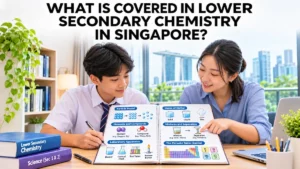
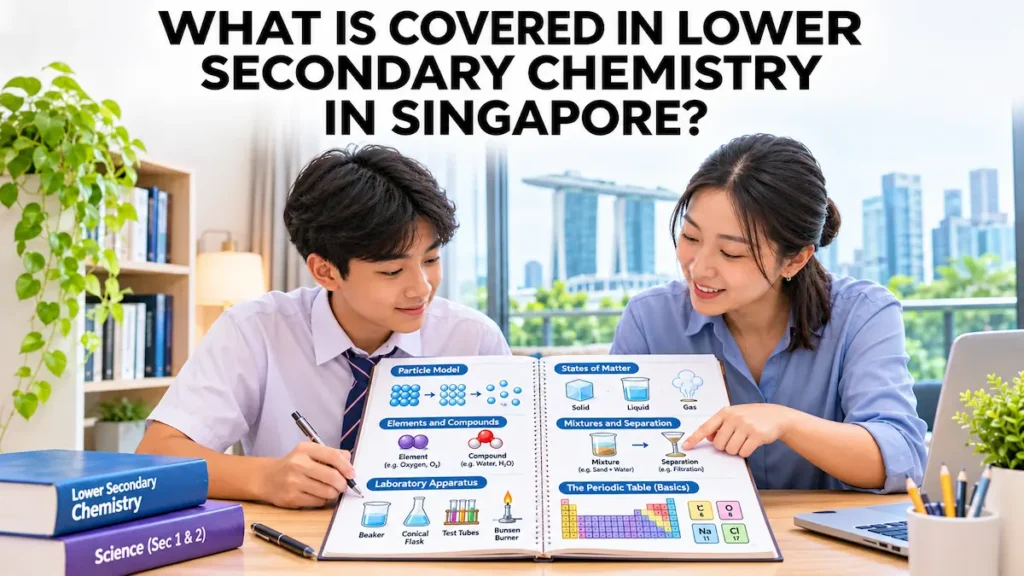
So what does that Chemistry look like? Mostly the basics of matter. What things are made of, how they’re sorted, how mixtures get separated, what happens to particles when things heat up, and a first look at acids and alkalis. This guide walks through the topics, how they lead into O-Level and SEC Chemistry, where students usually get stuck, and what you can do at home.
One warning before we start. Schools order the topics differently, and your child may be taking Science at G1, G2 or G3 level under full Subject-Based Banding. Treat the lists below as a guide and check your child’s school scheme of work for the exact order.
Quick answer: In Sec 1 and Sec 2, Chemistry is taught inside integrated Science. Expect matter and its properties, elements, compounds and mixtures, separation techniques, particles, atoms and molecules, chemical changes and acids and alkalis, plus plenty of lab work. Chemistry becomes its own subject (Pure Chemistry or Combined Science) in Sec 3.
Is There a Separate Chemistry Subject in Lower Secondary School?
No. MOE’s lower secondary Science syllabus is built around themes such as the Scientific Endeavour, Diversity, Models, Systems and Interactions. The Chemistry shows up mainly under Diversity (what matter is made of) and Models (the particle picture of matter), while Physics and Biology take up the rest.
Separate science subjects only start in upper secondary. If your child is heading for Combined Science, our guide on why Combined Science matters explains how that works.
Chemistry Topics in Lower Secondary Science: Sec 1 and Sec 2
The MOE syllabus doesn’t pin every topic to a fixed year. Some schools teach Physics, Chemistry and Biology as separate modules, while others mix them by theme. The tables below show a common pattern based on school content outlines, so your child’s school may order things differently.
What students typically cover in Sec 1
| Topic | What students learn | Key skills | Leads to in upper secondary |
|---|---|---|---|
| The Scientific Endeavour and lab skills | Safe lab practice, using apparatus, measuring, recording results and planning fair tests | Handling equipment, tables and graphs, drawing conclusions | Practical assessment in Chemistry and Combined Science |
| Diversity of matter: physical properties | States of matter and properties such as melting point, boiling point and solubility | Describing and comparing substances, reading data | Kinetic particle theory |
| Diversity of matter: chemical composition | Elements, compounds and mixtures, and how to classify matter | Classifying substances and explaining the differences | Chemical bonding and structure |
| Solutions and solubility | Solute, solvent and solution, solutions and suspensions, and what affects how fast and how much a substance dissolves | Planning fair tests, interpreting results | Methods of purification, and later salts |
| Separation techniques | Filtration, evaporation, distillation and chromatography, and when to use each | Choosing a method and describing the steps | Experimental chemistry and purification |
What students typically cover in Sec 2
| Topic | What students learn | Key skills | Leads to in upper secondary |
|---|---|---|---|
| Particulate nature of matter | Matter as particles in motion, and how particle arrangement explains solids, liquids, gases and changes of state | Drawing and reading particle diagrams | Kinetic particle theory |
| Atoms and molecules | The basic structure of atoms and how atoms join to form molecules | Using models and diagrams to explain ideas | Atomic structure and chemical bonding |
| Atoms, molecules and ions (some schools) | How charged particles form and how they differ from atoms and molecules | Distinguishing particle types | Ionic bonding and formulae |
| Writing chemical formulae (some schools) | Symbols and simple formulae for common substances | Memorising and applying symbols | Chemical formulae and equations |
| Chemical changes and word equations | Physical vs chemical changes, signs of a reaction and word equations | Identifying changes, writing word equations | Symbol equations and chemical calculations |
| Acids and alkalis | Indicators, the pH scale, properties of acids and alkalis, and neutralisation | Interpreting indicator results and explaining reactions | Acid-base chemistry and salts |
Key Chemistry Concepts Students Learn in Lower Secondary Science
Elements, compounds and mixtures
An element has just one type of atom. A compound forms when elements join chemically, and it behaves differently from the elements it came from. A mixture isn’t chemically joined, so each part keeps its own properties. Students mix these three up all the time, usually because the definitions sound alike until they’re tested on real examples.
Separation techniques
Each method suits a different job. Filtration takes out insoluble solids, evaporation recovers a dissolved solid, distillation separates liquids and chromatography splits coloured substances. Students need to pick the right method and describe the steps in order.
The particulate nature of matter
Everything is made of tiny particles that never stop moving. That one idea explains melting, boiling, diffusion and why a gas is easy to squash. Drawing and reading particle diagrams is a skill worth practising early.
Atoms and molecules
Atoms are the building blocks, and molecules form when atoms join. This is where chemical formulae begin, and it sets students up for bonding in upper secondary.
Chemical changes and word equations
Students learn to tell a physical change from a chemical one, and to write word equations such as “metal + acid → salt + hydrogen”. Symbol equations come later.
Acids and alkalis
Here students use indicators and the pH scale, then look at simple reactions, including neutralisation. It’s the first step towards Acid-Base Chemistry at O-Level.
Practical and Lab Skills in Lower Secondary Science
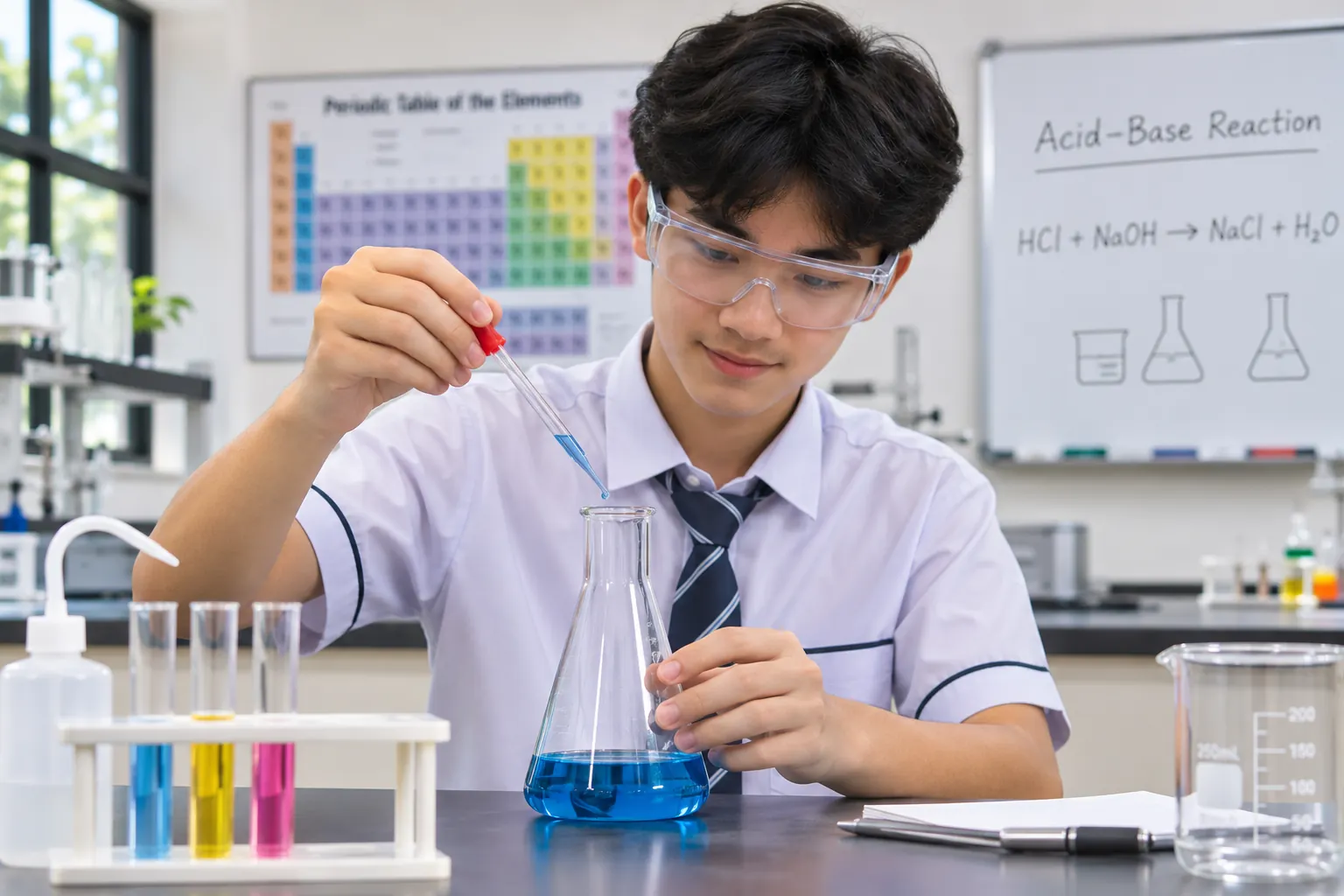
Science in Sec 1 and 2 is hands-on. Students learn to use apparatus safely, take measurements, record results in tables, draw graphs, spot patterns and write a short conclusion. It sounds basic, but it matters later, because upper secondary Chemistry and Combined Science both include a practical assessment.
How Does Lower Secondary Chemistry Prepare Students for O-Level and SEC?
Upper secondary Chemistry grows straight out of what students learn in Sec 1 and 2. School outlines list Experimental Chemistry, The Particulate Nature of Matter, Chemical Bonding and Structure and Acid-Base Chemistry among the early topics, and you can trace each one back:
- Elements, compounds and mixtures lead to chemical bonding and structure.
- Separation techniques lead to Experimental Chemistry and methods of purification.
- The particle model leads to kinetic particle theory.
- Acids and alkalis lead to acid-base chemistry and salts.
From 2027 the O-Level is replaced by the Singapore-Cambridge Secondary Education Certificate (SEC), so keep an eye on SEAB and school announcements for syllabus details. Either way, solid Sec 1 and 2 basics make O Level Chemistry and Combined Science much less of a shock.
Common Challenges Students Face in Lower Secondary Chemistry
Most of the trouble comes from a handful of things:
- Mixing up elements, compounds and mixtures
- Deciding whether a change is physical or chemical
- Drawing and reading particle diagrams
- Learning a whole new vocabulary of symbols and formulae
- Writing answers precisely enough to earn the marks, because a correct idea can still lose marks if it’s worded loosely
- Practical write-ups, especially planning a fair test
There’s a bigger problem too. Students who treat Science as three separate subjects, instead of linking Physics, Chemistry and Biology ideas, often struggle with application questions.
How Is Lower Secondary Science Assessed in Singapore?
Your child’s school sets the assessments, not a national exam. School timetables usually show weighted or chapter assessments through the year and an end-of-year exam, though formats and weightings differ from school to school. Expect a mix of short answers, structured questions and practical or data-based tasks. Understanding counts for more than memorised notes.
How Can Parents Help Their Child With Lower Secondary Chemistry?
You don’t need a Science background. A few simple habits go a long way:
- Ask your child to explain a topic to you. If they can teach it, they understand it.
- Use things at home. Dissolving sugar, separating sand from salt or watching ice melt all show the ideas in action.
- Make flashcards for key terms and symbols.
- Draw particle diagrams together and talk through what the particles are doing.
- Keep an error log. Write down each mistake, why it happened and the right explanation, then look back at it every week.
- Ask the school teacher which topics are weak.
- Don’t overload the week. A tired child learns less.
Not sure whether your child needs more than that? Our guide on the signs your child needs a private home tutor can help you decide.
When Should Students Consider Lower Secondary Science or Chemistry Tuition in Singapore?
Tuition works best when there’s a specific gap that school lessons aren’t closing. It’s worth considering if:
- Marks drop or stay low over several tests
- Your child keeps mixing up the same concepts
- Explaining answers in words is a struggle
- Your child avoids Science or says there’s too much to memorise
- A big step is coming, such as settling into Sec 1 or moving to Sec 3 Chemistry
Don’t wait too long. Science ideas build on each other, so a gap in Sec 1 can come back in Sec 3. For a full checklist on picking tuition, read our guide on how to choose the right tuition for your child in Singapore.
If you’d like a tutor who specialises in Chemistry, see how our lessons work in the next section.
Chemistry Tuition in Singapore With Mr Angus Chia at TutorSay
Meet your Chemistry tutor, Mr Angus Chia
Mr Angus Chia has spent 10 years helping students strengthen their Chemistry through private tuition, small-group classes and student care programmes. He’s a former student of St. Joseph’s Institution and National Junior College, an NTU alumnus, and earned 9 distinctions at the GCE O-Level examinations. His focus is simple: build strong Chemistry fundamentals, explain tricky ideas clearly, and teach the exam techniques students need.
Chemistry tuition options at TutorSay
| Option | How it works | Good for |
|---|---|---|
| One-to-one Chemistry tuition | Lessons tailored to your child’s pace, school topics and target grade | Catching up on concepts, final revision, or a student who learns best with full attention |
| Small-group Chemistry classes | Structured explanations, shared problem-solving and guided practice with school prelim papers and O-Level past-year papers | Students at a similar level who like working with others |
| Home Chemistry tuition | Lessons at home, with no travel after a long school day | Busy students and families who prefer home-based learning |
What the lessons cover
For Sec 1 and 2, we work through the Chemistry inside Science: matter, elements, compounds and mixtures, separation techniques, particles, atoms and molecules, and acids and alkalis. For upper secondary, lessons follow the MOE syllabus and cover topics such as chemical bonding, chemical equations, acids and bases, the mole concept and mole calculations, redox and organic chemistry. Combined Science students get the Chemistry half covered too.
How lessons help your child
- Clear explanations of why reactions happen, not just what to memorise
- Practice with equations and mole calculations until the steps feel natural
- Exam techniques for the multiple-choice, structured and practical papers
- Practice with school prelim papers and O-Level past-year papers
- Regular updates for parents on what was covered and what to practise next
Is it the right fit for your child?
It’s a good fit if your child needs Chemistry explained patiently, wants individual attention or a small group, or prefers learning at home. We teach the Physics and Chemistry combination for Combined Science but not Biology, and a tuition centre may suit a child who does best in a bigger class. A trial lesson is the easiest way to find out.
Have a look at our Lower Secondary Sciences Tuition, O Level Chemistry Tuition and Combined Science Chemistry Tuition programmes, or contact us to talk about your child’s needs.
Lower Secondary Chemistry in Singapore: Frequently Asked Questions
What Chemistry is taught in Sec 1 in Singapore?
Mostly lab skills, the diversity of matter, elements, compounds and mixtures, and separation techniques. The order depends on your child’s school.
What Chemistry is taught in Sec 2?
Usually the particle model, atoms and molecules, chemical changes and acids and alkalis. Some schools spread these across both years.
Is there a separate Chemistry subject in lower secondary?
No. In Sec 1 and 2, Chemistry is taught inside integrated Science with Physics and Biology. Pure Chemistry and Combined Science start in Sec 3.
When does Chemistry start as a separate subject in Singapore?
In Secondary 3, when students pick Pure Chemistry or a Combined Science combination. The O-Level gives way to the SEC from 2027, so check SEAB and your school for details.
What is the difference between an element, a compound and a mixture?
An element has one type of atom. A compound is made of elements joined chemically and behaves differently from them. A mixture isn’t chemically joined, so its parts keep their own properties.
Is Sec 1 Science hard?
Plenty of students find it a jump from primary school, because there are three sciences and a lot of new vocabulary. Regular practice and asking questions early usually make it manageable.
What do G1, G2 and G3 mean for Science?
Under full Subject-Based Banding, students take each subject at G1, G2 or G3 level depending on their strengths. The levels differ in depth and pace. Your child’s school can tell you how Science is offered.
How can I help my child with Chemistry in lower secondary?
Get them to explain topics out loud, draw particle diagrams, use flashcards for key terms and keep an error log. Talk to the school teacher about weak areas, and consider tuition if a clear gap isn’t closing.
Does my child need tuition for lower secondary Science?
Not always. It helps most when gaps keep showing up, confidence is low or your child struggles to explain answers. A trial lesson is a good way to find out.
Does TutorSay offer Chemistry tuition in Singapore?
Yes. Mr Angus Chia teaches Chemistry through one-to-one lessons, small-group classes and home tuition, from lower secondary Science to O-Level Chemistry and Combined Science Chemistry.
How long has Mr Angus Chia been teaching Chemistry?
Mr Angus has spent 10 years helping students strengthen their Chemistry through private tuition, small-group classes and student care programmes.
Start Your Learning Journey
Need Help With Lower Secondary Science?
Tell us whether your child is in Sec 1 or Sec 2, their school and which Science topics are causing trouble, and Mr Angus will suggest a suitable one-to-one or small-group plan.
Contact Us Today WhatsApp Mr Angus