In this guide
- 7 Signs Your Child Needs a Private Home Tutor in Singapore
- How Many Signs Mean It Is Time for a Private Tutor?
- When a Private Home Tutor May Not Be the Answer
- Why a Private Home Tutor in Singapore Can Help
- What to Do Next: A 4-Step Plan
- How Much Does a Private Home Tutor Cost in Singapore?
- Signs Your Child Needs a Home Tutor: Frequently Asked Questions
- Private Home Tutor in Singapore: How TutorSay Can Help
- Sources and Further Reading
Every Singapore parent knows the feeling: a test paper comes home, the marks are lower than expected, and the question appears. Does my child need a private home tutor, or is this just a bad week? With the PSLE, O-Level (the SEC from 2027) and a fast-moving school syllabus, it is hard to tell a passing dip from a real learning gap.
This guide gives you seven clear signs that a private home tutor in Singapore could help, a simple way to judge how serious they are, and what to do next without overcommitting.
Quick answer: The clearest signs your child needs a private home tutor are grades that stay low or keep slipping, the same mistakes repeating, homework that takes too long or ends in tears, falling confidence, and trouble coping with a big change such as Primary 6 to Secondary 1 or the O-Level/SEC year. Two or more signs lasting a term, or any sign in an exam year, is a good moment to act.
7 Signs Your Child Needs a Private Home Tutor in Singapore
A single bad test rarely means anything. As Singapore Tuition Teachers puts it, tuition is worth considering when the same academic pattern keeps repeating over time. Look for patterns, not one-off results.
1. Grades are slipping or stuck across several tests
One weak result can come from tiredness, illness or careless mistakes. But if marks have fallen over two or three assessments, or have stayed low despite real effort, there is probably a gap that school lessons are not closing. Check weighted assessments, class tests and year-end papers, not just the latest one.
2. The same mistakes keep coming back
Go through a few corrected papers. If your child loses marks on the same topics, such as fractions, algebra, chemical equations or forces, it points to a misunderstanding rather than carelessness. A private home tutor can pinpoint the root cause and rebuild it step by step, instead of moving on to the next chapter.
3. Homework takes too long, or ends in tears
Homework that regularly runs very late, needs constant help, or causes arguments is a signal. Your child may not understand the topic well enough to work independently. In a Singapore school week full of CCA, tests and travel, long homework sessions also eat into rest time.
4. Your child is losing confidence or avoiding a subject
Statements like “I’m just bad at Maths” or “I hate Science” often show that your child has lost confidence, not ability. Avoiding a subject makes the gap bigger. A patient one-to-one tutor can give your child small, regular wins, which is often what rebuilds confidence first.
5. A big transition is coming, or has just happened
Some points in the Singapore school journey are known pressure points:
- Primary 6 to Secondary 1: more subjects, more abstract Maths, more conceptual Science
- Secondary 2 to 3: subject choices, such as Pure vs Combined Science (see our guide on why Combined Science matters)
- Subject-based banding: with full SBB, students take subjects at G1, G2 or G3 level, so a mismatch in pace can show up quickly
- Exam years: the PSLE and the O-Level, which the SEC will replace from 2027
- Moving from an international school into the local system
Extra support at these points can prevent small gaps from becoming big ones.
6. The school teacher has flagged a gap, or the class pace is too fast
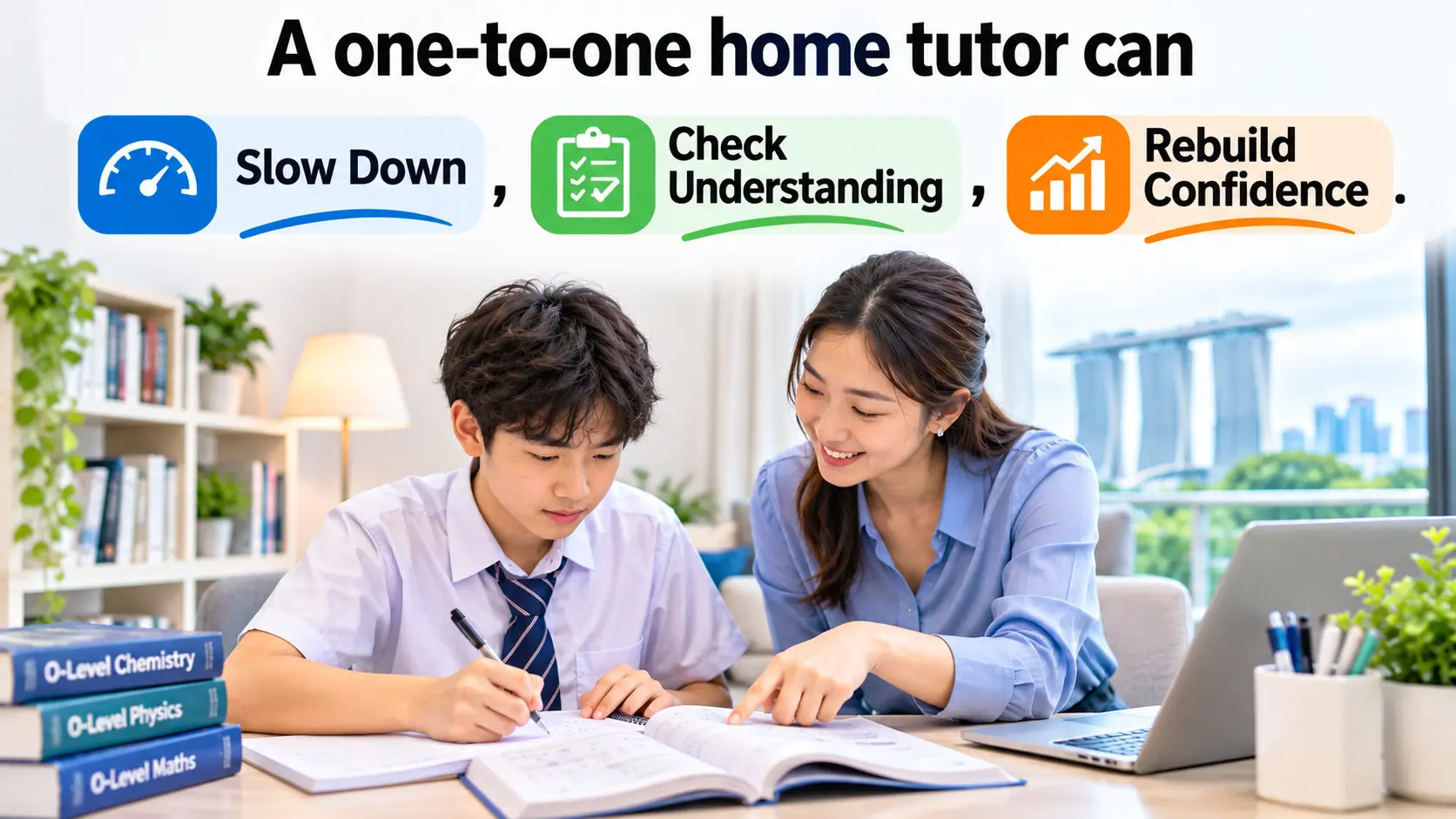
Your child’s teacher sees your child every day. If they mention weak areas, ask what exactly is missing and which topics to practise. If your child is bright but quiet and gets lost in a large class, a private home tutor can slow down, check understanding and fill in what the class moved past.
7. You have run out of ways to help at home
Many Singapore parents try to help with homework themselves. That works until the syllabus changes, the topics get harder, or the lessons turn into arguments. A neutral tutor can remove that tension. If you also suspect your child may have learning needs, such as dyslexia or ADHD, speak to the school and consider a professional assessment. A tutor can support learning, but a tutor is not a diagnostician or therapist.
How Many Signs Mean It Is Time for a Private Tutor?
Use this simple gauge:
| What you are seeing | What it usually means | What to do |
|---|---|---|
| One sign after one bad test | Likely a one-off dip | Talk to your child and the teacher, then watch for a month |
| Two or more signs lasting a term | A real gap is forming | Pinpoint the topic and try a trial lesson |
| Any sign during an exam year (PSLE or O-Level/SEC) | Time is limited | Act early with targeted help |
| Signs plus tiredness, anxiety or withdrawal | May not be only academic | Speak to the school teacher or counsellor first |
For a similar framework from another Singapore provider, see Tutopiya’s signs guide.
When a Private Home Tutor May Not Be the Answer
Tuition is not a cure-all. Kiasu Parents suggests asking whether your child needs to be tested for learning needs, actually wants to work with a tutor, and would benefit more from coaching or counselling.
A tutor is unlikely to be the first step if your child:
- Is exhausted from CCA, homework and school commitments
- Seems anxious, withdrawn or unhappy about school
- Has not been assessed despite clear signs of learning difficulties
- Strongly resists the idea, in which case talk first about what would make it feel useful
Adding another weekly commitment on top of an already overloaded schedule can make things worse.
Why a Private Home Tutor in Singapore Can Help
When the gap is clear, a home-based private tutor offers several advantages:
- Individual attention. Lessons target your child’s actual gaps, not the average of a class.
- A comfortable pace. The tutor can slow down on difficult topics and speed up when your child is ready.
- No travel after school. Home-based lessons save commuting time, which matters in a busy Singapore week.
- Flexible scheduling. Lessons can be arranged around CCA, tests and family routines.
- Clear feedback for parents. Regular updates show what was covered and what to practise next.
What to Do Next: A 4-Step Plan
- Pinpoint the gap. Review recent papers and ask the school teacher which topics need work.
- Set one clear goal. For example: rebuild basics, improve exam technique, or build confidence.
- Shortlist and trial. Speak to two or three tutors and try a lesson before committing to a package. Our guide on how to choose the right tuition for your child in Singapore has the full checklist.
- Review after 4 to 8 weeks. Look at your child’s understanding, confidence and homework, not only marks. Adjust if needed.
How Much Does a Private Home Tutor Cost in Singapore?
Rates depend on the level, subject and the tutor’s background. According to MindFlex’s 2026 rates, typical ranges for Primary 5 to Secondary 5 are:
| Tutor type | Typical hourly rate |
|---|---|
| Part-time tutor | $30 to $45 per hour |
| Full-time tutor | $40 to $65 per hour |
| Ex or current MOE teacher | $60 to $95 per hour |
Rates were checked in October 2026 and can change, so confirm what is included, such as marking, feedback and make-up lessons, before you decide.
Signs Your Child Needs a Home Tutor: Frequently Asked Questions
How do I know if my child needs a private home tutor?
Look for patterns over a term: grades that stay low or slip, repeated mistakes, long and stressful homework, lost confidence, or difficulty with a big transition. Two or more signs, or any sign in an exam year, is a good moment to seek help.
What age should a child start having a private tutor in Singapore?
There is no fixed age. The right time is when a real gap appears, not when other children start. Starting very early without a need can add pressure.
Is a private home tutor better than a tuition centre?
Neither is better for every child. Home tutors suit children who need individual attention, a calmer pace or a flexible schedule. Centres suit children who like routine and peer motivation.
How much does a private home tutor cost in Singapore?
Rates range from about $30 per hour for part-time tutors to around $95 or more for experienced or ex-MOE teachers, depending on level and subject. Check what the fee includes.
How many hours of home tuition does a child need per week?
It depends on the child and the gap. Many families start with one lesson a week, then adjust after reviewing progress in 4 to 8 weeks. More hours are not always better if your child is tired.
Can a private home tutor help a child with ADHD or dyslexia?
A patient tutor can support learning, but a tutor is not a diagnostician or therapist. If you suspect learning needs, speak to the school and consider a professional assessment, then ask the tutor about their relevant experience.
How long does it take to see results?
Often a few weeks to a school term. Early signs, such as better understanding, less stress with homework or fewer repeated mistakes, usually show before test marks do.
How do I know if I have hired the wrong tutor?
Warning signs include your child making the same mistakes week after week with no plan to fix them, vague feedback, and a child who is unhappy or no more confident after several weeks. Talk to the tutor first, then decide whether to adjust or change.
Private Home Tutor in Singapore: How TutorSay Can Help
TutorSay offers home-based 1-to-1 and small-group tuition in Singapore, led by Mr Angus Chia. Lessons focus on clear explanations, step-by-step guidance, targeted practice and exam techniques, with regular parent feedback.
Explore our programmes:
- Lower Secondary Mathematics Tuition
- Lower Secondary Sciences Tuition
- O Level Elementary Mathematics Tuition
- O Level Chemistry Tuition
- O Level Physics Tuition
- Combined Science Tuition (Chemistry and Physics)
Sources and Further Reading
- Tutopiya: 7 Signs Your Child Needs a Home Tutor
- Singapore Tuition Teachers: tuition guide for parents
- Kiasu Parents: Is Tuition Necessary for My Child?
- MindFlex: 2026 tuition rates
Start Your Learning Journey
Think Your Child Needs a Private Home Tutor?
Tell us your child’s level, subject and challenges, and Mr Angus will suggest a suitable one-to-one or small-group home tuition arrangement in Singapore.
Contact Us Today WhatsApp Mr Angus