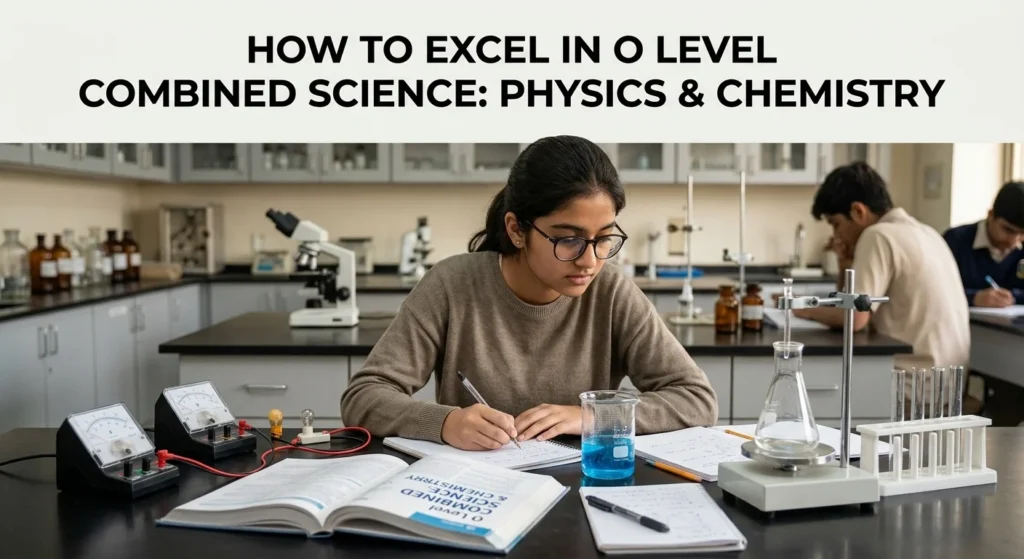
Discover practical strategies, smart revision techniques, and key study habits to master O Level Combined Science Physics and Chemistry for top exam results.
Studying for O Level Combined Science can feel overwhelming for many secondary school students. Managing both Physics and Chemistry under a single subject demands a clear strategy, strong conceptual understanding, and consistent practice. Whether you are aiming for top grades or looking to build a solid foundation, mastering these two core sciences is entirely achievable with the right approach.
1. Focus on Core Concepts Over Rote Learning
Physics and Chemistry in O Level Combined Science are built on fundamental principles. Memorizing formulas or definitions without understanding their real-world application often leads to confusion during exam conditions.
- For Physics: Concentrate on understanding key concepts like kinematics, forces, energy transfers, and electricity. Always try to understand the mathematical relationships behind physics formulas.
- For Chemistry: Focus on atomic structure, chemical bonding, stoichiometry, and the periodic table. Once you grasp how elements react and interact, answering theoretical and structured questions becomes much easier.
2. Master the Formulas and Chemical Equations
Both Physics and Chemistry require precision. In Physics, write down all key formulas in a dedicated notebook and practice manipulating equations to solve for different variables. Pay close attention to SI units, as missing units can cost valuable marks. In Chemistry, practice balancing chemical equations regularly and learn how to write word and symbol equations accurately.
3. Practice Past Year Papers Regularly
One of the most effective ways to prepare for O Level Combined Science exams is by practicing past papers. Time-bound practice helps you get familiar with the exam format, question styles, and marking schemes. When reviewing your answers, look closely at the examiner’s reports to understand what key terms are expected in structured questions.
4. Build Structured Answering Techniques
Exams test not only what you know, but also how well you communicate your knowledge. Use subject-specific keywords in Chemistry, such as “delocalized electrons,” “activation energy,” or “exothermic reaction.” In Physics, present numerical solutions step-by-step, starting with the base formula, substitution, and final answer with proper units.
5. Choose the Right Tuition Support
Whether you prefer personalized 1-to-1 guidance or interactive small group tuition, having an experienced tutor can significantly speed up your learning curve. A dedicated tutor helps identify your specific weaknesses, provides custom practice materials, and offers targeted feedback that self-study alone cannot replace.
By staying consistent, practicing past papers, and seeking structured guidance when needed, you can approach your O Level Combined Science examinations with complete confidence and achieve outstanding results.